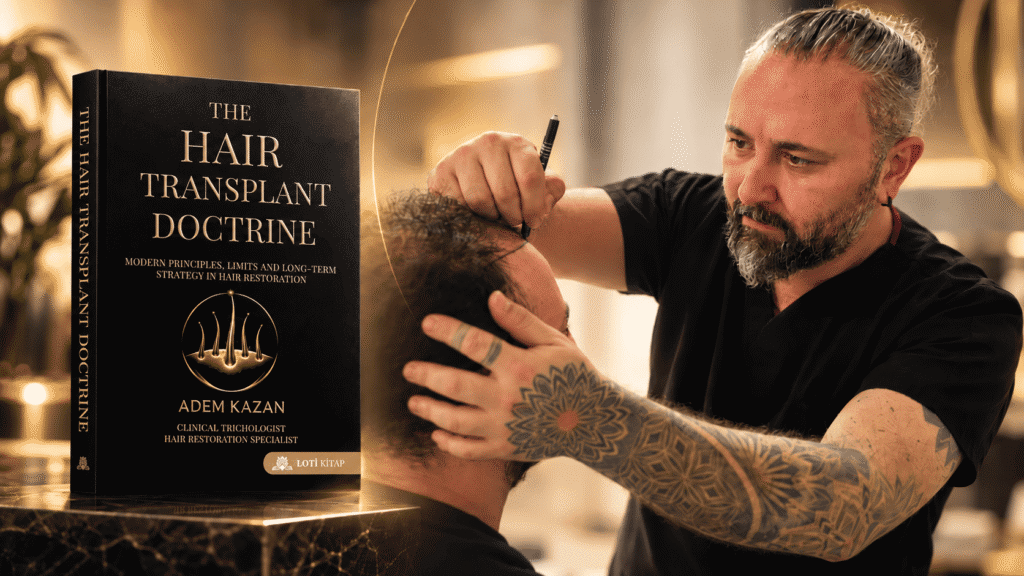



A new hair transplant planning book by trichologist and hair transplant specialist Adem Kazan, who leads the hair transplant team at Poliklinika Dijamant in Sarajevo, Bosnia and Herzegovina, asks a question often overlooked in discussions of hair restoration: what happens to the result years after the transplant?
In The Hair Transplant Doctrine, published by Loti Kitap, Kazan sets out the principles behind patient selection, donor-area management and long-term planning. The book argues that choosing a technique or counting grafts cannot replace an assessment of the cause and likely course of hair loss.
Hair transplantation moves follicles from a donor area to an area of thinning. It does not necessarily prevent the hair around the transplanted follicles from continuing to thin. That distinction shapes the book’s discussion of hairline design and the need to preserve options for later years.
Kazan also addresses circumstances in which surgery may need to be delayed or reconsidered, including unclear causes of hair loss and limited donor capacity. His emphasis is on the decision that precedes a procedure: whether a proposed plan is suitable for the individual and sustainable over time.
Written for a general audience, the 192-page book presents hair transplantation as a series of considered choices rather than a single-day solution.